❋
Cannons, larrikin mermen and a fairy palace
Nonfiction writing very close to home.
The cannons cemented firmly outside of my home were making me uneasy, so I wrote about them.
The apartment block that I call home perches at the lowest ebb of Northcote, a site that slips towards Merri Creek from Ruckers Hill. It is here that the stream turns in on itself in gentle clefts, resisting confluence with the Birrarung for just a little longer. A tributary must know its fate. Naming conventions require a clean break — the Merri cannot also be the Birrarung. The paths beside are a breath away from the musk damp and hushed conversation of the creek. I walk them, and so should you. On this day, the creek swells, a dull rippling tissu. There is much to commend this area to those who enjoy our remaining slips of urban greenery. Trees gather uninterrupted in a quiet copse: drooping sheoak, silver wattle, and gums manna, white, river red, and swamp. A handful of incongruities dot the scene: one lone cactus teetering near the rail bridge and what appears to be an avocado tree extruding from a cliff-face. The understory, as everywhere, is slowly being smothered by invasive Europeans — one doesn’t hold out much hope for the council-propagated tussocks against the marching monotony of introduced grasses.
The sharp inhalation of the land around the waterway affords me a view of treetops and freeway lights to the southeast. Everything beneath your feet genuflects to the Birrarung, and from the river to the sea. The purple quietness of the Dandenongs squats between ground and cloud due east. Autumn seems to amplify road sounds and commuter trains. The lucky few (alternatively: the attentive few) will catch the zappy, plaintive cluck of visiting pied currawongs. They compete with the shuddering light rail and swiftly accelerating cars down a generous boulevard lined by elms just outside.
Just over the road, a block of public housing units has been demolished in favour of a blended model development. Four cranes wheel high over the Merri, no doubt contributing their own fine particulate matter to a creek borrowed from the Woi-wurrung phrase for ‘very rocky’. Right now, it is a concrete ribcage half exhumed. The excavation works into the hillside were uncompromising. The tired units they replaced had been the home of ordinary Victorians since the 1950s. Before that, the site had held a notorious pub of which most records come from the courts. It was the location of several alcohol-induced accidental drownings in the creek, its publicans sold inferior schnapps, and it welcomed patrons well outside of legal operating hours.
Today, it is a monumentally privileged neighbourhood. Northcote doubles the national average of residents holding a Bachelor's degree or above. It over-indexes heavily on professionals and managers. A gentle progressivism can be inferred from the records: the largest employers of Northcote residents are hospitals, higher education, and the state government. It’s not a suburb on the up–it is up. The last vestiges of old Northcote, or what qualifies as old in this city, have been gussied up, renovated, and saddled with apartments. Just down the way is Sutton’s Tool and Gauge factory, a mighty red brick plumbing and electrical fittings works, once stinking with a 1000°C brass foundry, which after a century of operation was swallowed by units. Brown brick semi-detached homes (an easy euphemism for Mediterranean heritage) are now rendered and daubed in monument grey. Even the bad pub has been lined with navy carpet and gold trimming.
After running southbound and down for kilometres, High Street leaps across the emptiness above the Merri, simultaneously gaining a foothold and losing a name. The double-arched span was completed in 1875 under the watchful eye of one T.E. Rawlinson from the Department of Roads and Bridges. Of the draughtsman, we have plentiful records. The same cannot be said of the hundreds who blasted, hewed, and chiselled, worrying blue-grey basalt free from the earth at Malmsbury. It is a bridge consisting of the cliffs it cheats, and we should consider the cliffs.
During the Silurian period, an unfathomable 436 million years ago, my rental would have been many fathoms underwater. Layers of silt drifted down as the seafloor itself was forced begrudgingly upwards. Melbourne, characteristically and fashionably late, was one of the last places on the eastern seaboard to peer above sea level. That sediment was compacted sandstone and siltstone just below me. Glaciers came and went, though not in the notably un-glacial accelerated time-lapse footage we’ve become accustomed to on a heating planet. These ice masses, in the surprisingly touching words of the 2008 Darebin Thematic Environmental History report, “scoured off the wrinkles and flattened the land”.
The water would rise and fall several more times over the next 400 million years, exposing and drowning my suburb in slow succession. Plates and volcanics tugged insistently at the skirts of continents. The dinosaurs came and went. In the hot and wet Pliocene, barely a few million years ago, Brighton Group sands were dusted across the landscape. The remnants of that marine sand are still found just up the road, on Rucker’s Hill, where one can enjoy a charming panorama of the city. It was the loose earth that inspired Alexander Sutherland’s flight of fancy in a profile of Northcote published in The Argus on December 13, 1884:
“Whence or when this gravel was deposited there Professor McCoy may know; but anyone standing on the hill finds it easy to believe that the height appeared above the surface of the ocean when waves rolled over the surrounding low ground. On this very elevation, perhaps, when deep called unto deep across it, huge megalosaurs and mastodons fought, and the trampled earth shook beneath them. Palaeolithic men may have assembled on an islet a little to the south-west, and now known as Eastern Hill, and parleyed and wrangled, cracked jokes that have since become fossilised. Larrikin mermen and mermaids possibly played, fathoms deep, on what we call Collingwood flat, and mischievous sirens may have combed their back hair on the wavelet-kissed beach of the hummock on which the elegant mansions of Toorak now stand.”
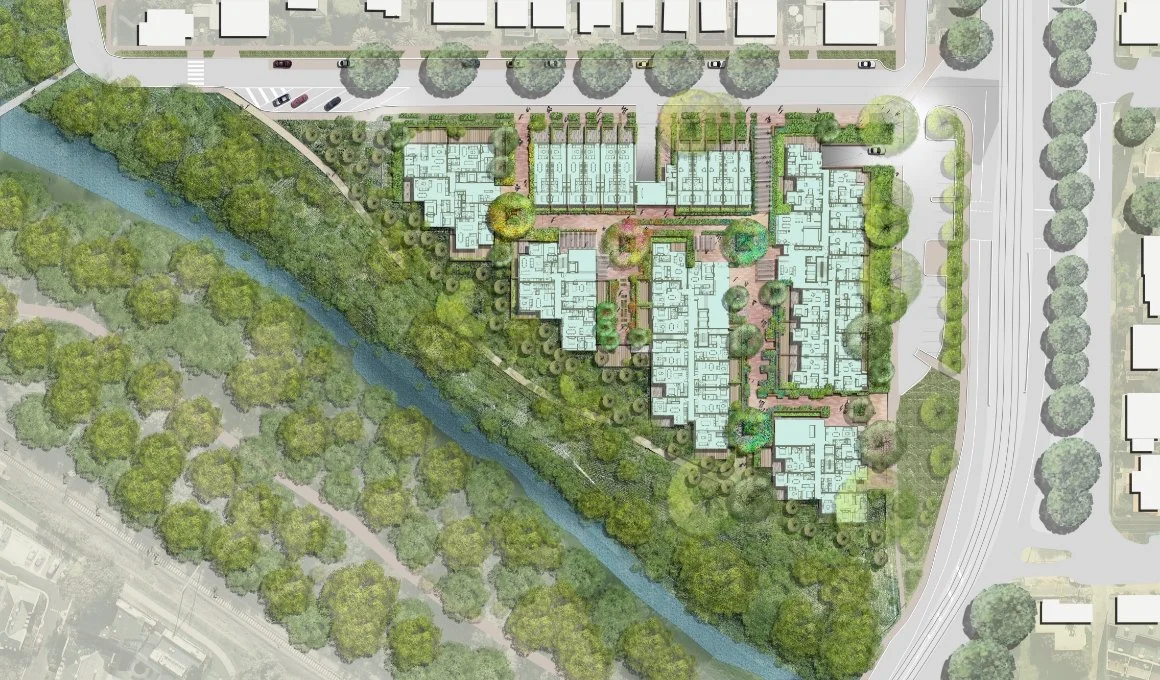
Photo from Merri Northcote
You won’t catch me dead describing a resident of Toorak as a mischievous siren. However, as a Victorian I am obliged to mention that we used to have a lot of volcanoes. Our great state was once home to 400 active pyres choking the sky and spitting basalt. One of them, Hayes Hill, is a rather unimpressive-looking scoria dome up near Donnybrook. These days it is on private land, though it is unclear whether the volcano recognises such legalities, or indeed the wire and post cattle fences hemming it in. I can thank Hayes Hill for belching out the sinfully hot basalt that forms much of my view. Lava flows, sometimes 30 metres deep, crept down the catchments and filled the old channel of the Merri Creek in search of the sea. This ashen cortege lost its momentum near the CBD where it met the Quaternary lava flows that blotted out the west.
It took great heat, violence, and time to plug the waterways; it may as well have been a child damming a backyard rill. Rain fell unperturbed by where it landed. It forged the only path it could. Rushing water simply ate into the softer Silurian silt beside the hardened basalt. Deeper and wider it carved a line against the basalt. This re-homed creek swallowed earth and, several hundreds of thousands of years later, spat out a pleasant morning walk. On my way to the coffee shop, the Merri’s tight bends are dominated by smoky saxe walls of exposed lava. If you stand underneath the High Street bridge, where the space and stone give the traffic above a sonorous quality, one can follow a bike path downstream to see where we too have eaten the land. Ungainly open spaces have filled the gouges where beast and man tugged out cobblestones, hearth walls, and bridge struts. It would be quite poetic if the vast foundations of the High Street bridge were eked out of the canyon walls downstream, but unfortunately, we’ve already established that they came from Malmsbury.
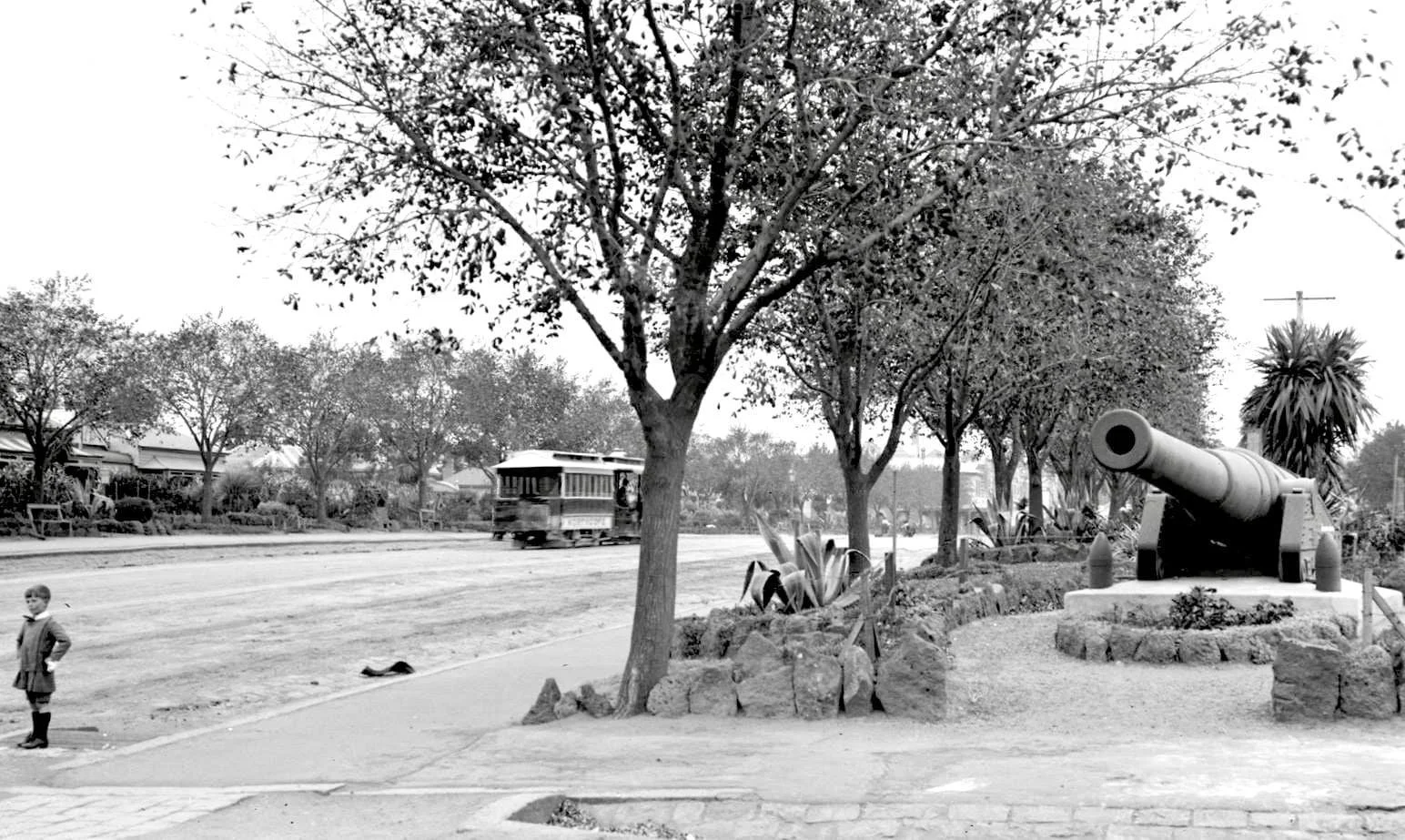
My immediate environs include the following: cars parked in an unorthodox fashion; the handsome All Saints church, which opened its doors to parishioners in August 1860; expansive rockeries for native shrubs that are saturated with litter; several weeping pepper trees; a careworn street library; and, perplexingly, coastal artillery. A pair of 12-tonne cannons guard the entrance to the suburb, barrels drawn on the High Street bridge. They are shop-worn things, sagging low on their carriages, which does nothing to dispel the eeriness of unspoken violence. Oxidation around the breech handles speaks to better days. Up close, they demand your touch—the cool mass of liquified-and-set metal rips one back to a workshop with no air or light. There is a crushed soft drink can in one of the muzzles right now. In 1989, a local councillor quipped that they were aimed at the yuppies in North Fitzroy. A good bit, although one that has been defanged by three decades of upwards mobility in Northcote proper.
How easy it is to overlook them. One’s eye passes over these impolite anachronisms and dispenses with the very thought. Northcote is hardly a suburb in the throes of martial zeal. The last census recorded just 29 active ADF personnel in the suburb (and likely not a single one trained in 140-year-old artillery). These engines of war have been neutered, defused, and cemented in place. They’ve passed into history and are prone to being strip-mined for teachable moments. Worse yet, they are objects of the past that are lost in the present. Beyond Remembrance Day poppies and the odd Anzac Day poster, Northcote seems a suburb largely disinterested in war.
These are Armstrong 8-inch Mk.VII 8-inch guns. The name W.G. Armstrong & Co. once adorned sprawling satanic mills along the waterfront in Newcastle-upon-Tyne. William George Armstrong founded the Elswick works in 1847 to manufacture his patented hydraulic cranes before finding more sinister and profitable products. The early 1850s saw a significant British and French expeditionary force join their Ottoman allies in the Crimean War. The tsar’s designs on turning the Black Sea into a Russian lake led to a profligate and avoidable war on the peninsula. It was nominally a conflict over the rights of Orthodox worshippers living in Ottoman-administered Palestine, though it was propelled forth by Europeans jostling over control of an empire in decline.
Of all the oddities to emerge from that ridiculous war, none is more pleasing to the soul than Timothy the Tortoise. In the second year of the war, a Mediterranean spur-thighed tortoise was found aboard a Portuguese ship and taken in by one Captain John Guy Courtenay-Everard of the Royal Navy. 19th-century herpetology was admittedly still an inexact science, and it wasn’t for many decades that it was discovered that Timothy was a female. Timothy died in 2002 on the grounds of Powderham Castle, the ancestral seat of the Earl of Devon. She was 160 years old. Timothy’s owners, the Courtenays, are one of those tenacious, bloodthirsty, and scarcely believable aristocratic clans. Their blue blood leaks back in the history books to the Third Crusade. Notable Courtenays include a King and Queen of Jerusalem (they kept the seat warm for Saladin) and a Latin emperor of Constantinople (in the spirit of transparency, it should be noted he was in exile the whole time). If only Northcote venerated the tortoise.
During the campaign in Crimea, the London brass was made aware of its deficiency in field artillery: their unwieldy cannons were left axle-deep in that infamous Russian mud. Armstrong was awarded the tender to improve the lethality of UK arms. The contrivance that emerged from Elswick represented a great leap forward in cannonry. Rifling inside the barrel expelled a spinning and therefore aerodynamically stable projectile. Welded coils around the inner tube created a more durable and accurate barrel, but it was the improvement and popularisation of the embryonic breech-loading design that shook the world. Rather than hefting a shot up and into the muzzle, a method which had not been improved in the preceding 600 years of humans using gunpowder to shoot one another, Armstrong came in through the back. It was a revolution in small-bore mobile field artillery.
In the following years, the Armstrong gun was used to devastating effect in a series of British campaigns. They spewed fire onto Qing forts and towns during the Second Opium War. One cannot enforce a drug monopoly without regular and ritual displays of power. Then, in 1863, the British turned their new artillery on the Waikato Māori in an effort to crush the Kīngitana movement. How could one ever begin to catalogue the precious flesh rent open by Armstrong’s device? Bodies, once so durable, were left crumpled. Cannons to aid in the arson that consumed the greatest example of imperial Chinese architecture, the Summer Palaces. Cannons to smash Māori self-determination at the behest of uneasy settlers. What a unique contribution to our species.
Armstrong’s own thoughts on his power over life and death are a matter of public record: “It is our province, as engineers, to make the forces of matter obedient to the will of man; those who use the means we supply must be responsible for their legitimate application.” It tracks with screaming fidelity author Max Porter’s characterisation of contemporary Englishmen producing the weapons being used against the civilian population of Gaza: “At no point during the production of this lollipop do I need to know who’s going to end up sucking it.”
It was not just a cruelly effective weapon but an artefact of a squandered future. Armstrong’s fascination with hydraulics inspired one of the most extraordinary homes in Britain. Cragside sits higher up in Northumberland. The former hunting lodge was expanded between 1869 and 1882 into a ludicrous Tudor revival seat. Richard Norman Shaw was given a broad remit to imagine “a future fairy palace”. His finished product leaps out of the crag, a red-roofed fortress topped with whitewash and Tudor beams. Crenellations were a fitting nod to the renowned arms manufacturer. It is believed to be the first home in the world to be lit by hydroelectric power. A steampunk reverie of hydraulic dumbwaiters, early washing machines, and a hydroelectric rotisserie. At the height of his fame, Armstrong hosted the Shah of Persia and the King of Siam, which is to say nothing of his own royalty. This owner of white-hot kilns and deafening machine shops had a courtesan’s grasp of pomp and circumstance. In August of 1884, the Prince and Princess of Wales arrived at Cragside, their procession lit by 10,000 lamps, Chinese lanterns, and balloon-launched fireworks. One wonders whether some of those decorative lanterns were survivors of the incineration of the Imperial Summer Palace. When the National Trust catalogued the estates that should be bought into the public domain, Cragside was number one.
The Armstrong gun represented the future of British armaments. But in 1863, a British military commission appraised older muzzle-loaded artillery alongside the breech-loaded contraption. The former was inferior in all aspects bar the most important one: it was cheaper. At Elswick, the machinists turned their eyes seaward: ships, cannons to mount on ships, and cannons to sink ships from the shore. Northcote’s 8-inch guns are the latter. And, contrary to unpopular belief, the pair drawing a bead on the yuppies of North Fitzroy (Clifton Hill, really, given the barrel orientation) are the lighter 25-calibre variant MK.VIIs.
Coastal artillery would not have been much use in 19th-century Britain’s primary zone of concern: Central Asia. The Great Game (or, the Tournament of Shadows, as it was known in Moscow) was a hot-and-cold frontier conflict between the two powers. As Russia enveloped the steppe and desert khanates, it nudged its imperial border closer to the British profit centre of India. What followed was nearly a century of shadowboxing with diplomats, spies, and regular military incursions across Afghanistan, Persia, and Tibet. When Tashkent and Samarkand fell to Russia (in 1867 and 1868 respectively) a shiver was felt throughout the British imperium. There’s nothing like the ambiguity of a distant war to frighten the provincials, even those down in the South Pacific.
The Russian scare of the 1870s and 1880s sent colonial administrators scrambling for coastal defences. Could a squadron sailing out of Russian Manchuria menace Auckland? History provides a fairly straight answer: there were rarely more than two naval vessels flying the Russian tricolour within 1,000 miles of Tāmaki Makarau. What is it about the inhabitants of fresh colonial projects being most inclined to believe they’ll be dealt the same treatment? Was the fear shaped by the living memory of gunboats pouring fire on Māori trenches at Rangiriri not two decades earlier? Take this anecdote of one scared and confused man from J.N.W. Newport’s history of the South Island town of Collingwood.
“On the last day of August 1885 the Edwin Bassett, a wooden vessel of 397-tons register, owned by the Union Steam Ship Company, went aground on the coast south of West Wanganui Inlet [...] The crew escaped with only the clothing they wore and a few things which were washed ashore. The vessel, pounded by heavy breakers, broke up within half an hour of going ashore. A man from Collingwood going down the coast saw men camped on the beach and decided that New Zealand was being invaded by a foreign power so rode all the way back to Collingwood to inform the police!”
Over the ditch in the Australian colonies, preparations for the phantom Russian fleet were well underway. The twin forts at Point Nepean and Queenscliff already bristled with weapons. Their interlocking fields of fire earned the defences the nickname ‘Victoria’s Gibraltar’. Of the two island bastions planned, only South Channel Fort was constructed; an artificial mass of bluestone, concrete, metal, and sand heaped on a shoal 6 kilometres off the coast of Sorrento. It would have been a brutal test for any ships that made it through the narrow heads, if indeed it was ever put to use. And yet a fort without a cannon is no fort at all. An arms expo hosted in Melbourne in 1881 featured a stall from the renowned British weapons manufacturers Sir W.G. Armstrong & Company. Of particular interest to the local authorities were the 8-inch Mk.VII 8-inch guns. A pair were purchased from the mother country for £9,000 in 1887 and installed in 1890.
Armstrong’s cannons—my cannons—enjoyed a short and uneventful career. They were made obsolete by newer weapons, decommissioned after six years, and wound up at the naval facility in Williamstown. The Russians never came. Neither did the Germans (either time). Today, South Channel Fort is a breeding ground for white-faced storm petrels and recently hosted a Mildlife gig, which feels like a historic wrong being righted. The guns languished in Willy until they were snatched up by the Northcote South Ratepayers’ Association (a bone-chilling concept) in 1913 to add a little pugnacity to the sleepy suburb. Now they’ve slipped into the background—just a surreal glimpse out of the window of a tram packed with tired commuters.
In January, I was delighted to see them dragged back into the present. Some unknown party spray-painted the phrase ‘NO WAR’ on the barrel opposite my apartment. Similar messages were daubed all across the city as the bombardment of Gaza reached a level unseen in modern history. A cri de coeur. What better place could there be for a critical reflection on the impact of state violence than on its tools? Naturally, the graffiti was scrubbed off. Either by a zealous historian or a contractor under the employ of Darebin Council. It seems that an engine of war is an inviolable object. A cannon can only bring death; peace is beyond its skill set.
It’s a strange word to hold, let alone object to wield. ‘Cannon’ is a nod to form and is derived from the Romantic words for reed. It traces back through Latin (canna), Ancient Greek (kánnā), Akkadian (qanû) to Sumerian (gi.na). It is once we reach our first civilisation that the reed finds its rightful place at the centre of the universe. In the alluvial plains and marshes between the Euphrates and Tigris, the common reed (Phragmites australis — no relation) proliferates. They were used in construction, ceremony, warfare, and domestic tasks. The word for raft (gi-a-dag) is a compound of reed plus water, plus resting place. Gi-šà-sur, or sieve, is reed, plus intestines, plus to drip. Religious structures, torches, medicines, and snacks were all right there in the fibre. In southern Iraq, patient hands still bend and knot pliable reeds. The mudhif, or reed house, has been built in the area for 5,000 years. Contemporary examples are cathedrals in their own right: intricately patterned thatch, generous vault ceilings, delicate screens for airflow and decorative columns. That they are still being produced speaks to the tenacity of the Ma’dān who survived Saddam Hussein draining the marshes and flattening knowledge holders.
Stepping off the path towards the Merri one is surrounded by manifold reeds and rushes. While none reach the great heights of the Phragmites australis, there are clumps and sproutings of knobby club rushes, common sedges, austral gypsywort, and many more. In a slight breeze, they quiver and murmur to each other. Every blade was once an eel net or snare, a basket or sling. Now the flood-line moves every year and so many rushes are reduced to a sodden muddy mess or swallowed by faster-growing grasses.
You’ll find garish, plucky yam daisies peppered along banks of the Merri where the introduced species haven’t swallowed everything. The Woi-wurrung name for these yellow-blossoming beauties is murnong. Its long flat-toothed leaves lance out around exceptionally bright flower heads. They are fine things and by no means the product of luck or fate. Local Indigenous cultural groups and assorted ‘Friends of’ environmentalists weed, clear, turn, and plant along the Merri. Murnong pump their nutrients into a knuckle-wide tuber below ground during the year. In spring, meadows became a blooming carpet, a canary plea for harvesting.
The tubers themselves were a vital source of carbohydrates to the Wurundjeri-willam clan for thousands upon thousands of years. There is a vanishingly small blood-sugar spike from eating them either raw or cooked. Nature’s bounty multiplied by the careful hands that aerated the soil and removed edible tubers to leave the root structure intact. The Wurundjeri-willam have been on the land here for at least 40 millennia. Spring and early summer saw them on the move, harvesting murnong and gathering bird eggs and game. As the heat faded, the Merri gave up a treasure of eel and fish. Abundant country.
Until 1835, that is. The year John Batman charted the Yarra at the behest of Tasmanian pastoralists with an eye to hack open the interior. He was welcomed by the Wurundjeri and presented to them what is cynically described as a treaty beside the Merri. Whether it was countersigned is a matter of significant debate. Whether the terms were understood is not: the gravity of the text could not have been known by one of the two parties. We know what was offered: 20 blankets, 100 knives, 30 tomahawks, 200 handkerchiefs, 30 mirrors, 50 scissors, 100 pounds of flour, 6 shirts. We know what was taken: 600,000 acres of Kulin Nation country. The land grab that followed was hastened by disease and dispersal. Ultimately, the Batman Treaty was declared void by colonial administrators and was replaced by a totalising authority. In 1837, Robert Hoddle surveyed the land my apartment block sits on and, within three years, it was gazetted and sold off to land speculators and graziers. All of it bound up, overlaid with straight lines, and defended in the European fashion. Cloven imports fed on and trampled the murnong fields. Waterways were shockingly fouled.
Northcote proudly displays the names of the shock troops of capitalist imperial expansion. The hill I walk up each day is named for a land speculator who claimed the high ground. I can easily find information on the gold surveyors, tobacconists, sailmakers, dairy farmers, and drill bit company owners. Some of their homes still stand in the quiet backstreets. There are not so many plaques for the overwhelming majority of the Wurundjeri-willam who were dead or dispersed within 20 years of Batman’s arrival. We can’t spray paint ‘NO WAR’ on smallpox, tuberculosis, or syphilis. The City of Darebin has not kept the clubs, knives, and rifles that drove the Wurundjeri off the land.
Not long after the graffiti on Armstrong’s cannon was chemically removed, a Palestine sticker was stuck in its place. It too was shredded off as if to say: a cannon is a cannon and it is for our use only. Who is included within the definition of “our” is still a live question here. Today, Merri Creek runs ersatz jade as it ferries sediment, pollutants, and torn-up Palestine stickers downstream. Beneath volcanic cliffs half-remembered behind droll grey creepers, under the stern mass of the bridge and the cannons threatening it, and into a broad curve of the Birrarung. It will run the whole way along the sunken river at the bottom of the bay, around the skirt of South Channel Fort, and into the sea.