❋
What is Aaron Bushnell owed?
A personal piece to make sense of a life.
This piece was written for a personal project, The Wrap. All views are my own.
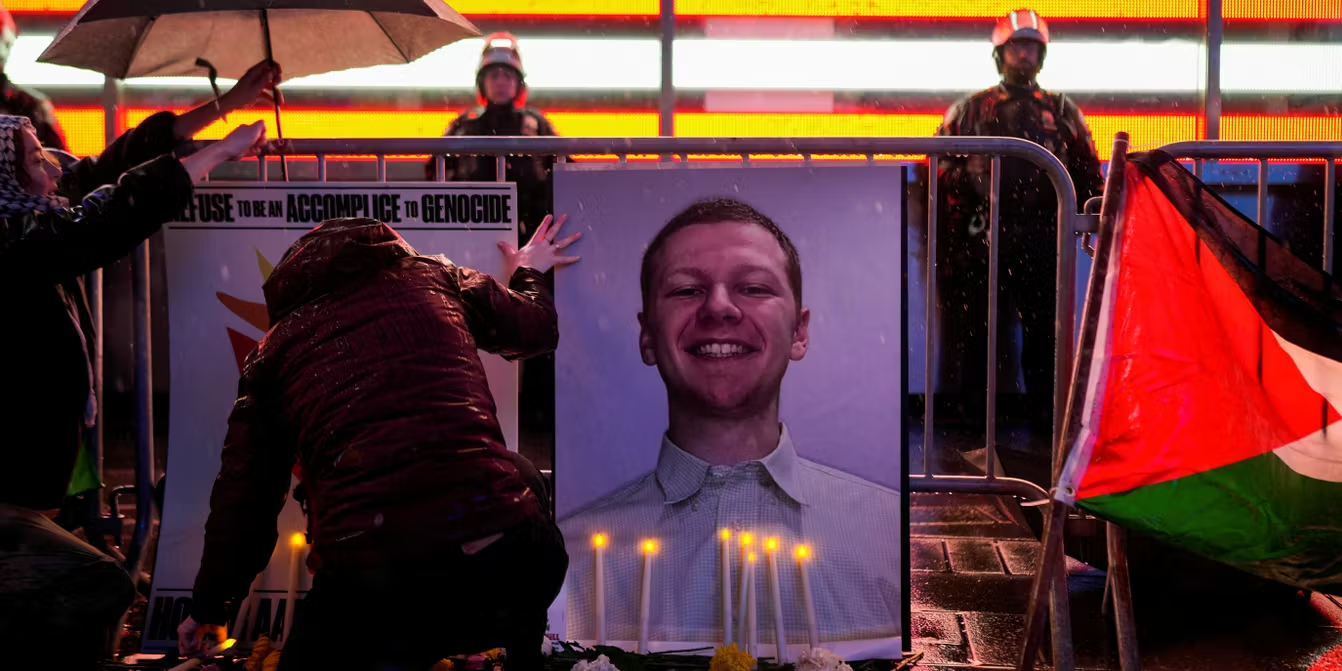
Indelible words. Ones that cannot be taken back or unread. By now you will have seen footage of the 25-year-old Aaron Bushnell self-immolating outside the Israeli embassy in Washington DC. There is nothing ambiguous about this self-sacrifice; his motivations could scarcely be clearer. A serving senior airman in the United States Air Force believed the country he had sworn to protect was enabling genocide. He protested against it. This, more than any other action a human can take, demands you follow its logic. Rather, we watch pundits raking over the peculiar details of his upbringing or political philosophy. So much arm-chair pathologising. These are the unconscious reactions of a body-politic that seeks to localise aberrant behaviour — to explain it is to explain it away.
Did Aaron Bushnell die by suicide? I don’t believe so. It looks to me like a final act of studiously non-violent political protest. St Thomas Aquinas (sorry) argued that when faced with evil, endurance is a nobler path than aggression. Bushnell could have struck out against those who bear greater responsibility; instead he endured agony. Was there a moment before losing consciousness that he realised the pain outweighed his belief? Would it even matter? Aaron Bushnell’s job required him to give his life for the American project — just not like this.
This may sound macabre, but I’d encourage you to watch the uncensored video. He streamed his death to Twitch to be seen, not abstracted. The sanitised footage (insofar as you can sanitise an act of this magnitude) autoplaying on news sites is insufficient. Flames lick up from the street and around the edges of the vision. Fogging out his form strands Bushnell in between meaning and nothingness: fumbling with the lighter, the warm orange fire burbling up from accelerant, his staggering pain and eventual collapse. Give him the meaning and death he chose. Bear witness.
One study I came across this week (Is Morality Unified? Evidence that Distinct Neural Systems Underlie Moral Judgements of Harm, Dishonesty, and Disgust) had some fascinating insights into moral perception. Participants were hooked up to fMRI machines and asked to respond to the moral quality of sinful behaviours. The neural map showed different areas of the brain reacting to each stimulus. Dishonest transgressions fired up regions associated with mental representations, multiple perspectives, and attentional reorienting. Disgust was associated with activity in several areas, notably the amygdalae, that relate to social-emotional processing, affective responses, and social conceptual understanding. But harm, physical harm, “recruited areas associated with understanding and imagining actions […] as well as a region of the precuneus implicated in self-centred visuospatial imagery strategies.” In witnessing physical harm we draw it inside of us. We embody physical harm, flinching or gasping.
Some weeks ago I wrote that artificial famines are not particularly good at killing fighting aged males but very, very effective at killing children. I have not been adequately prepared for what I am seeing before me: so many babies, eyes unfixed and startled wide, dying of hunger. This week Melania Ward, CEO of Medical Aid for Palestinians, reported that in northern Gaza one in six children under the age of two were experiencing acute malnourishment. In her words, “This is the fastest decline in a population's nutrition status ever recorded. That means children are being starved at the fastest rate the world has ever seen.” Ward described her colleagues on the ground in northern Gaza running out of horse and donkey feed to eat and have turned to bird seed. There are hundreds of aid trucks lining the border crossings into the Gaza strip that are arbitrarily held up by the Israeli army.
This is a choice. Not one of those hard decisions saddled on up by the past that must be grimly endured. Its an active choice to acquiescence to the starvation of a civilian population, one ratified daily in the political and military organs of Washington DC. When asked about what the State Department is doing to open the Erez border crossings, one of its flaks mewled, “I don't have any updates on it other than it continues to be a high priority for us.” The learned helplessness is stunning. If the imperial core does not have the ability to stop its protectorates from firing tank rounds into crowds of hungry people rushing a food truck then it is truly time for Xi Jinping to give it a crack.
Bushnell witnessed physical harm being inflicted on the civilian population of occupied Palestine. He was just a computer guy who’d seen enough. And here we fall (or at least I do) into a familiar pattern of thought that is neither novel nor easily shaken. What are the psychological and social ramifications of being exposed to all of the world’s misery on the same little rectangle you use to watch old clips from the Naked Gun or see photos of a friend of a friend who has fallen asleep in a bin? Technology has cranked open the limiting valve on reality. I suppose it doesn’t really matter how piecemeal, concentrated, or algorithmically-derived Bushnell’s understanding was. He saw, he felt, and his moral circle widened to include the shellshocked and starving people of Gaza.
The unparalleled Masha Gessen penned these words in pursuit of Bushnell’s purpose: “Under conditions of democracy, people act politically because they think that their actions can lead to change. They cannot effect change alone, and change is never immediate, but their experience tells them that change is possible and that it is brought about by the actions of citizens. When people do not believe change is possible, most do not act. Authoritarian regimes rely on a passive citizenry. Totalitarian regimes mobilise their subjects to imitate political action, but in a way that never brings about change. The vast majority comply. But a small minority can’t stand it.”
Once someone is within your moral circle of responsibility you are compelled to act in their favour. All of us know that insistent tugging within when personal inaction grates against that impulse. I quite enjoy Kant’s formulation of how we arrive at moral action, in which he denigrates, “when men hope to produce more effect on the mind with soft, tender feelings, or high-flown, puffing-up pretensions, which rather wither the heart than strengthen it, than by a plain and earnest representation of duty, which is more suited to human imperfection and to progress in goodness.” Duty–plainly and earnestly evinced.
How can we conceive of Bushnell’s clear sense of duty? Simone Weil’s placed rights below obligations in moral hierarchies. It is a pleasing inversion of the self-satisfied accumulation we see around us. In hearing the expression of rights Weil was overwhelmed by, “the shrill nagging of claim and counterclaim”. The French philosopher and her pals spent the wasting years in post-War Paris examining a new type of compact. Weil’s The Need For Roots is a marvellous tract, and contains more than a few relevant asides for us (the most aggressive cultures are those that have been uprooted and will that upon others).
At every level of our culture we are guided towards the notion that self-sacrifice, particularly of your life, in protection of another, is the highest of all acts of moral dignity. It is the fulfilment of an unspoken obligation. Nowhere is this more true than in depictions of martial self-sacrifice: taking a halberd / arrow / bullet for your friend. Boromir making good and getting got; Bruce Willis playing Bruce Willis in Armageddon (1998);“hello boys, I’m back” from Independence Day (1996). It’s a trope! Whether helping Hobbits, drilling into asteroids, or flying an FA-18A Flying Hornet into an alien spaceship, there is a measure of action and self-denial present.
In Morality and Self-Sacrifice, Martyrdom and Self-Denial, George Kateb speaks as purely as a church bell pealing on a pale winters day: “The fact that cannot be mastered is that there are always unaddressed wrongs in society or the world that should receive a moral response that requires some self-sacrifice […] At the limit of self-sacrifice is the willingness to die for the sake of acting morally; at the limit of self-denial is the willingness to die for the sake of principle.” From one angle Kateb differs from Aquinas in his reading of action/endurance. In Socrates’ death the former sees a preparation to endure loss rather than be complicit with wrongdoing.
There is a history here, a deep history, of self-destruction in the name of principle. Will Bushnell be remembered as fondly in two millennia as Socrates is today? Only time will tell. Paul Weiss, writing in 1949, picked away the primary issue here in Sacrifice and Self-Sacrifice: Their Warrant and Limits. It is a difficult read today. There is some very of-its-time postulating about the mentality and character of those who suicide. There is one fascinating section in which Weiss explores self-sacrifice on behalf of preserving the law. Admittedly it is not a core tenet in the text, but one that I feel intuitively. “A state is inferior to us in concreteness, sufficiency, power, reality,” she writes. “When we act on behalf of it we endow it with substance, increase its value, incidentally making ourselves more meaningful because more a part of a rational objective order.”
Bushnell reified the state by giving his labour to it. He was rewarded with moral injury. So what options are available to the injured party? Voting? Show me someone who can identify a gap in Israel-Palestine policy between the two major US parties and I’ll show you a liar. Protesting? I do that most weeks. Beyond the sublimation of spiritual pain into solidarity, it’s not moving the needle that much. These questions drew me back to a typically bossy essay from Leon Trotsky titled Whither France. It was written on the other side to Weil, Camus, and the rest of the gang. In 1934 Trotsky exuberantly predicted a future for France not dissimilar from contemporaneous Nazi Germany. He runs through his list of bugbears: France’s Bonapartist impulses, the cooption of workers movements by “vulgar democrats”, and the impotence of parliamentarianism. It’s the last point that hangs around like a bad smell.
Here’s a man who had little to give. Bushnell’s last will and testament bequeathed his cat to a neighbour and the root beers in his fridge to a friend. Small gifts. To Palestine he gave the totality of his being. An extreme act, and one concerned with extremities. The farthest reaches of his wandering mind, the expanding boundary of his moral circle, and the margin between Bushnell and the world — his skin. These are his wishes:
“I wish for my remains to be cremated. I do not wish for my ashes to be scattered or my remains to be buried as my body does not belong anywhere in this world. If a time comes when Palestinians regain control of their land, and if the people native to the land would be open to the possibility, I would love for my ashes to be scattered in a free Palestine.”
No funny stuff today.
Sit with Aaron.
Understand his wishes.
Free Palestine.
“I will no longer be complicit in genocide. I’m about to engage in an extreme act of protest but, compared to what people have been experiencing in Palestine at the hands of their colonisers, it’s not extreme at all. This is what our ruling class has decided will be normal.”